
Research
The pillars of my research can be categorized into the following areas: German Idealism (especially Kant and Hegel), Continental philosophy (especially Marx, Deleuze, and Badiou), social and political theory, the philosophy of history and memory, and the psychoanalytic theory of Freud and Lacan.
My work articulates the myriad of ways time and historical memory influence and condition our individual and collective experiences on a personal and societal level. Since psychoanalysis provides an epistemic and interpretative methodological alternative to traditional philosophy, it enables me to direct my research towards different yet tangentially related topics of investigation surrounding the function of cultural memory in the development of unconscious drives and desires.
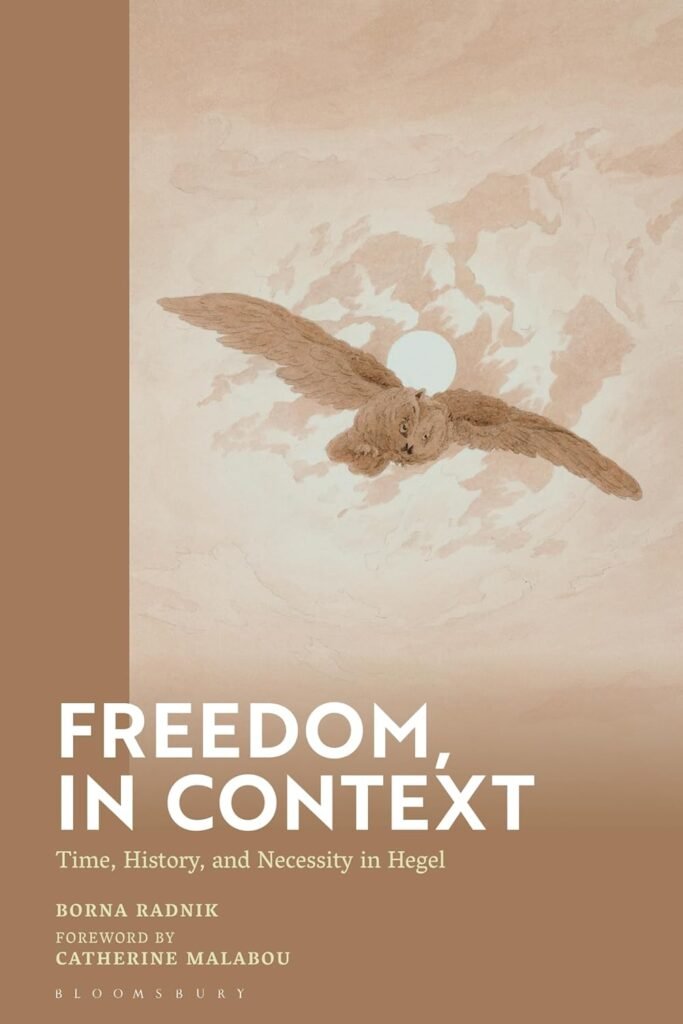
My book, Freedom, in Context: Time, History, and Necessity in Hegel, recontextualizes my interpretation of the dialectic of freedom and necessity in Hegel’s thought by expanding on how my central claims and arguments bear on Hegel’s relationship to Marx and Marxism. Underscoring the centrality of temporality and history in the formation of Hegel’s idea of self-determining freedom, I show how Marx’s adoption of Hegelian dialectics can be interpreted as an extension of Hegel’s project of the actualization of freedom in history. I stress how the essential relation of freedom and necessity bears on the capitalist mode of production, specifically how Marx’s reliance on Hegel’s dialectical method informs his understanding of history and its consequences for human self-determination. Another addition to my PhD thesis in the book is that I connect my reading of Hegel’s idea of freedom to contemporary social and political movements such as Black Lives Matter, and the Iranian Woman, Life, Freedom movement.
The Dialectic of Nostalgia
For years I have been fascinated with nostalgia as an emotional and psychic experience and as a contradictory philosophical concept. Can our experience of nostalgia teach us anything about our understanding of history, time, memory, sense of self, and political utopia? How does homesickness for a particular place structure our perception of time? How does nostalgia differ from and relate to experiences of melancholia and mourning? These are just some of the central questions that inform my exploration of nostalgia. My research on nostalgia is part of a larger, in-progress, book project titled The Dialectic of Nostalgia. Within the next five years, I aim to complete a monograph of 45,000 words on the philosophy of nostalgia. Although nostalgia has a rich history in modern European philosophy, it has mainly been examined as a sub-category of psychology and human emotion and has not received extensive philosophical investigation as an isolated concept. More substantial and recent philosophical and theoretical studies on nostalgia emphasize its intellectual history, its sense of belonging or feeling at home in a specific place, and how our experience of nostalgia, memory, and place informs our understanding of self and the world.
The Dialectic of Nostalgia asks why nostalgia has become one of the defining political and emotional structures of the twenty-first century. Why do societies increasingly organize themselves around fantasies of return precisely at the moment marked by technological acceleration, ecological crisis, mass displacement, political fragmentation, and the collapse of collective futurity? The book argues that nostalgia has become historically central because it expresses a constitutive contradiction within modern historical consciousness itself. Nostalgia is not simply longing for the past, nor reducible to sentimentality, memory, homesickness, or reactionary politics. Rather, it emerges from a dialectical contradiction internal to our modern conjuncture: the impossible desire to return spatially to what has been lost temporally.
I aim to interrogate the concept of nostalgia from a philosophical as well as psychoanalytic perspective, with a focus on its temporal and historical dimensions. I argue that the concept of nostalgia is essentially temporal as well as historical and that this temporality is contradictory in two ways. First, our nostalgia for a bygone era seems to appertain to the past. However, it attests to our dissatisfaction with our present. circumstances and affirms a desire for a different future. Second, the temporal-historical dimension of nostalgia necessarily involves a displacement of a particular place. Our experience of nostalgia as a feeling of homesickness and yearning for a place distorts and supplants the place in question and reveals a shift in emphasis from place to time. My philosophical approach produces the necessary framework to appreciate and explore its contradictory nature. In this project, I specifically use Hegel’s conception of dialectical contradiction , his understanding of time and history, and his concept of recollection to grasp the contradictory nature of nostalgia. I expand on Hegel’s ideas through the incorporation Freud. The book argues that nostalgic spaces often function as screen memories masking deeper attachments to lost temporality itself. Through melancholia, deferred action (Nachträglichkeit), repression, fantasy, and the uncanny, Freud reveals how nostalgia retroactively reconstructs the past through present dissatisfaction and desire. The nostalgic object therefore becomes simultaneously familiar and alien: the homeland or childhood home appears intimately known yet irrecoverably distant. The uncanny emerges not simply as spatial estrangement but as temporal dislocation.
The Dialectic of Nostalgia rethinks nostalgia not as sentimental longing but as a contradictory structure through which subjects negotiate historical irreversibility, displacement, and the collapse of collective futurity. Building on my earlier work on temporality and historicity in Hegel, the book develops a philosophical framework for understanding why contemporary politics increasingly seeks redemption through fantasies of impossible return. This is therefore not simply a work about memory or emotion. It is a book about contradiction, historical time, and the increasingly unstable relationship between past, present, and future under contemporary capitalism.
The Political Theory of Andor
Why has the Star Wars series Andor (2022; 2025) become such a politically resonant cultural object at the present historical moment? Why has a series produced within one of the world’s largest entertainment franchises come to articulate contemporary political anxieties more convincingly than many explicitly political works?
In a forthcoming book project, I argue that Andor has become compelling because it gives narrative form to a central contradiction of contemporary political life: systemic transformation appears historically necessary, yet the collective capacity to imagine, organize, and sustain revolutionary change remains deeply blocked. At a time marked by political exhaustion, normalized surveillance, technocratic administration, ecological crisis, and deepening inequality, Andor stages the problem of revolution not as triumph or inevitability, but as difficulty.
Andor offers neither revolutionary victory nor ideological consolation. There is no chosen one, no moral transparency, and no assurance that political struggle will succeed. Instead, rebellion appears fractured, improvised, decentralized, and costly. The series asks what political commitment looks like when history offers no guarantees. This is what makes Andor politically radical. It does not present revolution as an accomplished event. It presents revolution as a historical problem: necessary, urgent, and profoundly difficult to imagine, organize, and sustain.
That problem resonates far beyond the series itself. Andor speaks directly to a contemporary experience of bureaucratic domination, resurgent far-right populism, political fatigue, fractured solidarity, and the lingering sense that the present persists less because it is legitimate than because alternatives remain nearly impossible to imagine, much less to realize.
The book’s central conceptual lens is Huey P. Newton’s idea of revolutionary suicide. For Newton, revolutionary action does not proceed from confidence in victory but from the refusal of resignation. It names commitment undertaken without guarantees of success, survival, or historical vindication. Through this lens, Cassian Andor and the wider network of insurgents emerge as figures who act not because triumph is assured, but because complicity has become intolerable. The book traces this contradiction across five interconnected dimensions of the series: structures of domination, sacrifice, political desire, collective hope, and historical agency.
Across its two seasons, Andor depicts resistance as an uneven historical process. Season 1 begins with localized violence, surveillance, labor exploitation, and everyday coercion on Ferrix and Morlana One. Season 2 expands outward from isolated acts of defiance toward the fragile architecture of collective insurrection. What links both seasons is a central political question: what sustains rebellion when there is no charismatic leader, no stable political horizon, and no certainty that sacrifice will matter?
I develop this argument through three interconnected theoretical frameworks that move from domination, to desire, to collective persistence.
First, G. W. F. Hegel provides the framework of history and freedom. The representation of freedom in Andor does not precede struggle as a moral ideal; it emerges through contradiction, conflict, and historical necessity. The series repeatedly shows how individual actions become historically consequential in ways that exceed intention or control.
Second, Fredric Jameson and Jacques Lacan provide the framework of ideology and desire. The Empire governs not merely through force, but by structuring what subjects can imagine, tolerate, and desire. Rebellion begins not with political clarity but with dislocation: a fracture in the symbolic order that had previously rendered domination natural and inevitable.
Third, Byung-Chul Han provides the framework of endurance and persistence. In Andor, hope is not optimism or faith in progress. It is the minimal persistence of collective action under conditions of uncertainty.
Taken together, these frameworks allow the book to show why Andor has become politically resonant now. The series does not offer a revolutionary program or utopian solution. Rather, it dramatizes the contemporary crisis of political imagination itself.
This project explores why a work like Andor has become politically compelling at a moment when revolution appears historically necessary yet increasingly difficult to imagine or actualize.